
Your First Surfboard
126 commentsYou can learn to surf on whatever board you like, but some surfboards are more appropriate than others. To maximize the rate at which your surfing progresses, you need to get started on the right board. You didn't start your driving lessons in a Ferrari, and you don't want to learn to surf in a Ferrari. (You know what we mean!) So what is the anti-Ferrari of surfboards?
The Soft Surfboard
If you've ever had surfing lessons with a surf school, you already have a good idea as to which surfboard is best for the beginner. It's a soft surfboard. Sometimes called foamies, these soft boards are ideal because the soft foam construction means the boards are incredibly buoyant, enabling the beginner to catch waves easily. Their dimensions ensure that they are very stable in the water, making it much easier for the novice to stand up.

The fact that they are soft makes them an ideal board for a surf school where any injuries are minimized. (Even the fins on this design are soft to a certain degree.) An ideal soft surfboard length for an adult is around 8 feet in length. A softboard around the 6 feet is best suited for a child.
However, while ideal for a single surfing lesson, softboards aren't perhaps the best surfboard to buy for an adult who will be surfing regularly. Most people quickly outgrow these boards, not making them the best buy. For small children who won't progress in surfing so quickly, or for adults who only go surfing on vacation once a year, they are a great buy.
The Pop-Out
A pop-out is a surfboard that is made on a production line and is a cheap alternative to a custom-made fibreglass surfboard. The pop-out is made of foam covered with thick fibreglass and is practically indestructible. As a result of their construction, the pop-out is much heavier than a softboard or a custom. The weight reduces the performance of the board, which is good from a learner's point of view; the board is much steadier in the water.
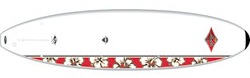
The downside of these boards is their weight, meaning that they can pack a hefty wallop. When using these boards you need to pay attention to where the board is going if you come off it, and be aware of other people in the water.
The pop-out is a popular choice as a beginner board, and they offer more to the average surfer than softboards because they have a longer time span where they are still of use as a board to learn on. Another great thing about the pop-out is that they are in demand and always have a good resale value after you've learned to surf on them, as others commonly try to find a second-hand board.
Summary So Far
So we've taken a look at what can be classed as the "traditional" beginner surfboards. Let's sum up what we've found.
Soft surfboards are suitable for everyone as a first board, and because of their construction, the size of the board doesn't really matter. An eight-foot board is ideal for an adult, while a six-foot board is best for a child. The downside is that they are quickly outgrown, and a new board will be needed by someone who gets into the surf regularly.
Pop-out surfboards have a longer life than the softs, and they can take a surfer from complete novice to intermediate surfer without the need for a new board. They also have an excellent resale value when looking to trade up. The downside is primarily their weight and that they are incredibly hard to duck dive.
There is one problem with both these boards: they have a zero cool factor. This is why many surfers can be put off from buying them even though they make great beginners surfboards.
Let's take a look at custom surfboards for beginners - are they a better option or just a solution to the cool factor?
Spanish Version: Tablas de sur para principiantes
You Might Also Like
- Information on the Surfboard - What's What?
- Surfboards For Beginners - What's best?
- How to Attach a Surfboard Leash - 5 Easy Steps Showing You How
- Comprehensive Guide to Surfboard Fins - Flex, Rake and more
- Surfboard Wax For Non Slip Surfing
- Surfboard Advice Forum
- Surfboard Shop
- Tablas de sur para principiantes. ¿Cuál es mejor?
nice
cool, thanks
Thanks! This was very helpful!
Thanks! I'm just a ten year old girl! This helps a lot!!! I can't wait to start!! Well, I know how to paddle! PEACE!!
While this states an 8' soft is good for an adult learning it goes on to state the "Pop-Out" could be a better choice for the first buy. This does not say if the 8' is still the best size. Is the 8' "Pop-Out" the right size for an adult?
i have never done surfing but i want to try
If i m 5foot 9"..how long should my surf board be
8 foot is a good size for a first board.
For Mr (or Mrs) 5 foot 9, the choice of board depends more on your weight, your surfing ability, and the time that you will spend in the water.
The guys over on the forum helped me with my first board choice a while ago. You should register on the site and post your questions there.
Hope this helps you.
I guess I would be classed as an improver... I have a 7'10" Take-Off but read recently that this brand is not ideal... any input on this?
thanks for the interesting information
This is a really interesting and informative content.
im 5'6". nd im 13. how should ma board be??
How much does a pop out surfboard cost and how much would it be for shipping?
@Guest on Jul 15, 2011: Take off boards had a bad repuration a few years ago, but have since improved. You've bought it now, so how are you getting on with it?
@Linda: Popouts cost from around
very helpful. thanks
Hey. I was wondering if someone with experience can give me advice on buying a starter surfboard. I want to learn, and found a Maui and Sons 8' cheap surfboard, I know I would eventually buy a 'real' surfboard, but what do you think about getting this as a learning board? thanks in advance!
Hi Eva, I'm not familiar with Maui and Sons surfboards, and without knowing the full specs of the board, and your weight, it's not possible to give a definitive answer. That said, 8' is a good length for a beginner. A cheaper board is also a good choice for a first board - you might not like surfing (unlikely).
Hey Surf patrol. Thanks for responding. The board is PE (or soft) topdeck, X-band core, square tail. I weigh about 120, and i m 5'7.5. thank you!
Eva, it sounds like it's a board that is suitable for a beginner, the sort of board you would find at a surf school.
If you surf regularly, you might find that you outgrow the board quite quickly and would need to change for something that will offer you better performance.
If it's cheap, you can't really go wrong as a starter board
Hey Surf patrol! Thank you for your feedback - I've been wanting to surf for a while now, and unsure about the board/equip requirements. I stumbled upon one really cheap and was hopeful. All I need is something that you would use to learn on. I am super excited about it! Have a good day!
I'm 5"3. I'm guessing that a 6" is the right size soft board? I live in South Eastern NC, and the waves are barely huge here unless you head to the Outer Banks. But I want to surf so I'm preparing myself. Everyone goes surfing during hurricane season. Any tips?
i had an el nino 6''4 board, it was sort of foam but not quite...but i have progressed a bit now and am leaning towards getting a new board, possibly fiberglass or pop-out.
i'm about 5''3 and i'm looking for a board of similar length or a bit shorter? any ideas
thanks in advance (:
Hi. My 14yo daughter wants a surfboard for Xmas and we are not sure which type of board to go for. I have been told by people that surf that if we bought her a soft board that she would have to relearn if she ever got a fibre glass board.
If your daughter has never surfed (and this goes for any newbies) I would say don't buy a surfboard until she's had some fun learning in surf school.
She may change her mind if she doesn't enjoy it, it's not for everyone and is certainly harder and more physical than the pros make it look!
I don't agree that a soft board would mean she would need to 'relearn'. It's great to learn the basics on. Epoxy or custom boards are going to take some ajusting to of course.
hi i am moving to brisbane and im only young and still dont no witch surfboard to buy
sos what surf board should i get
The best thing i would do is try your mates boards or hire from a school and see what works for you before you buy one. Myself learning from experience i bought 5 boards before i found one with the exact dimensions that suit me. Its always best to try it out first, get a feel of it before spending and getting the wrong thing. Alot of shops will tell you what you need, but they dont know your paddling capabilities or how quick you can get up and ride etc.
What surfboard should i get for a beginner
Hi my 10 yr old daughter has been learning to surf on foamies at school and prefers them to the fiberglass short board a friend gave her. I have put a 7" foamie on layby for her. Do you think this is to big? Should I swap it for a 6 " board or will she grow into it?
hi im 11 and i need a board i weigh around 100 pounds and am 62 inches any advice I HAVE NEVER SURFED BEFORE!!!!!!
Please help and respond! Im turning 16 about 5/10 165 and i have been surfing since the summer and i excelled very quickly at least i think. And i ride a Costco foam board its pretty anoying because everone has no respect for me because of my board. I get up and ride the face of nearly every wave and i need a new board ive asked people and i get mixed oppions on what to buy from friends. i want a longboard because i like catching a lot of waves. but i dont know what to look for i need help!
Thanks for setting me up dude
Interesting that you recommend 8 feet for an adult...my instructor had me learn on a big, hurkin' 12 foot soft paddle board, since I'm 6'2 and about 225 lbs. I needed the wideness (a paddle board is wider than a longboard).
Thanks, it really helped me make a decision.
thats cool
I've been surfing for 30+ yrs ... you do not need to waste $ on a new board when you are learning. Buy second hand, heaps better value, and then upgrade as you get better. For younger kids <8 go for softboards ... adults and kids 10+ go for fibreglass minimal or mal. 8-10 yo depends on size, strength, athletic ability etc ...
what sizes for 9 year old girls
It depends on your height and weight.
Hiii.(:
I'm 4'9, and im 13. what board should i geT?
Thankyou this really does help a surfer in progress like me!
his this is gonna help so much thanks now i can choose what kind of surf board to make for myself.
i am 14
im 11 and have been surfing my whole life although my friend wants to learn how to surf, she is 11 and is wondering what she should learn on she is about 172 cm and can't wait so please respond ! <3 thank you !!
thanks for the info! ;)
fricken sponge boards are way too heavey
ok im a beginner i know how to surf a little but i want to buy the right type of board for me i am 6 ft 4 and im 15 and im confused on what to buy should i get a long board or short board or mid plz help ???? thxs BRAHS
Hey im a 15 year old girl, 5
Hey, I haven't started surfing yet, but my family just bought a beach house. I really want to start surfing right away. I'm 11 years old, about 85 pounds, and 5 feet tall. I am on tennis team, field hockey team, and a swim team, so I would consider myself pretty athletic. Any recommendations?!?
Great, can't wait
that wuz helpful but u should put the prices for the boards
Iam 14 and now the theory of how you surf and practice on a rug what board should i get :-D
Hi there
I'm looking to buy a surfboard for my boyfriend. He's roughly 6'1 and 83kg, never surfed before but due to him relocating to the seaside will be learning to surf and going quite regularly. Would appreciate any advice on what board would be most suitable! Thanks.
i am 13 and i watched soul surfer and really wanted to try to surf i was on the swim team and i play tennis twice a week for 1 hr 30 min so i weight about 102 and im 5.11 in height so what should i get???
I love surfing already and I just stared since we recently moved to the beach! I'm eleven years old and surfing rocked! I just got a new fun board!
thanks that helped heaps.i am only 11 but cant waite to start hitting the waves. :) hang loose
thx
Hi, I'm an 18 year old boy that weighs about 210 lbs and I'm 6' tall. I have wanted to surf for years now but never knew where to start. I wanted to know if anyone could help me with what size board I should get?
What is the cool factor?
Re What is the cool factor? It's the big buck companies telling you you WILL be cool if you buy/wear/use their over-prices sweat-shop manufactured merchandise silly!
im 14 130 lbs athletic and 5'6in. i have wanted to surf for a while but dont know what board to get i was looking at a 6 foot soft board foamie Measures 72" Tall, 20.5" Wide, 2" thick will this be a good board for me? PLEASE HELP ME OUT thanks
I just started looking for surfboards tonght. I already know how to paddle, stand and duckdive but my ride length is not the best. My friends have boards and i want one now. Im 14. 95 pounds. 5' 5" and really athletic. What board type, length and price limit be?
Im looking for a board im 13, 105lb, and 5" 2" what is a good length for me??
Im looking for a board im 13, 105lb, and 5" 2" what is a good length for me??
i am 24 and workin in a surf shop but i don't know how to bsurf and luckily i am now beginning to learn!!!
Hey...
I'm a beginner and looking for a board that fits me and a country of small waves. Is a 6,4" too little?
i have been boogie(body)boarding ever since i can remember. but i want to advance to the next level. a bunch of kids on my beach ride catchsurf boards. they look fun cheap and easy, but imm not sure if that is a bad starting board because of how small they are. any suggestions?
im 12 and 5'1 what size board should i get ? ( answers plz ) THANXS
Hi I'm 12 and I'm 5 ft 2in what size board and what kind of board should I get? I have never surfed before but have tried on a boogieboard
i am a begging to surfboard and i have no idea what board to start of with but i want a small board-ANSWER PLZ
laura and lauren is 12 and jamie is 10 what size boards do we get???
HHHEEELLLPPP!!!
Thanks this helped a lot! I've taken two surfng lessons in my life (one was today) and I would like to get a board so that I can improve. I don't want to get into compitition surfing, just some surfing for fun. I think that the soft board would be best for me considering I'm only 12. This helped a lot:) Thanks!
okey......i have a dauter and im teaching her to surf but she dose not know how to swim its crazy and she is 9 ok i dont know wat bord to get her and see is pickie at wat bord she wants so i wat to get her a costum bord that she want but i dont know anyone that will do it OMG ok hope someone write back lolplease help me now ASAP
im 6"3 what size board do i need and i weigh 225
im 159 cms. How long should my board be ?
I just need to get a surfboard for my son ben
It's ok
Hey , Why are you buying sutch big board it makes no reson JUST buy a board above 6' and it will be mutch fun learing and surfing . Big boards ar KAK
I'm 5'4", 16 years old, and 100lbs! I have surfed before, twice. Which board should I get?
im 14 and 5ft i have been surfing for 3 years which board do you thinks will be good for me
i have almost die cause of surf boards i hate those things
I am 6ft 3 (17yearsold)and have never surfed before and aim interested in buying a board but which one is best
Looking for a surfboard for an 11 yr. old girl. She has taken surfing for the last 3 years and instructors said the boards from costco would be good starter boards and good price. Anywhere else i can get a comperable board? Do not see them at costco. Thanks!
Great advice, lived in cornwall all my life, spent everyday of the hols at perranporth, but never learnt to surf ! 45 now so time to give it a crack - anyone know of a beginner friendly shop down this way :-)
lekker im from plettenberg bay i just started surfing great advice
Hi I am 12 turning 13 in June, I am 4"9 and weigh 103lbs. I have never surfed before and I cant take lessons cause' I live in Pennsylvania. I can only surf in the summer on vacations. I am a beginner and I want to buy a board to teach myself. I know how to paddle and stand up to catch a wave. Is that all I need to know? If anyone has more information e-mail me please with what kind of surfboard I need and what size and what else I need to know at Nicolejoann00@gmail.com . Thanks (:
I want a fibreglass surfboard and it needs to be a "6.5" What board would you suggest. Not over 500$
Laura and Jamie and Lauren, You should get a fome one and make sure its a long board cause, u would have more space and they are better to balance on it.
Hi I'm 24 120lbs, 5'7. I skated before and have tried surfing on long board once. Should I get shortboard or practice more on longer board?
thank you very much
Longboards are the best beginner boards.
I agree, to learn from an 8 foot foam board is an excellent board to learn from. I am a 5 foot petite female and it's been pretty fun and easy for the most part on this board. The Costco 8 ft foam board a little wide for my arms though. It's my second year now and want a board that's easy to carry. I think I would like a 6 or 7 ft foam board to try so I can carry with ease. :) Fell in love with surfing tho-super fun and addictive, just need to find more friends to go out and surf with!
If you are a beginner where's the best place to buy a a surfboard
Vixen is a great option for everyone that want a fast ride in smaller waves. The surfboard comes with tons of different design options that many female surfers will love. I hope, you also will like it.
This was not very helpful.
Hi, I was wondering what size board should I have, I weight 40.1kg and I am 12 , I need to know!!! Thanks
thanks but please a bit more info and boards
I'm 165cm and 60kg have surfed on a foam board regular about a year ago. Is 6ft 10 a decent size for a fibreglass board I have no idea of sizing but will be riding regularly!! Thankyou :)
I'm 12 and moving to Michigan and want to learn to surf. What size board should I get?
Hi, I am 19 years old, 5 ft 3 and weigh 55kgs any suggestions of board types? I have never surfed before but I am super keen to start these holidays :)
I live in wisconsin and surf lake michigan. Best bet is a nine foot softtop surfboard. Buy a Greco board. They last and float high and catch waves like crazy. You'll learn fast. Give real boards a couple of years. Till u know what u need. Soft tops are always good here.
im 11 and im 4 foot 10 would the eight foot still be the best for me I found a 5 foot eight one but would that be harder,
I don`t know if this has already been asked but might as well ask it. I`m 5`1 and weigh 108 (Im a female) I suppose I`m a beginner and everyone is saying `as a beginner you want to start out with a longboard because with a short board you`ll get frustrated`` I totally understand that, but my friend learned how to surf strictly on short board and did fine, she said it was more difficult but because her mom is a well-known surfer she might have helped her out a big more. Because i`m not that tall, and I feel like I could really master a short board if I put in a lot of time and practice, should I still go through with getting a longboard or can I jump into getting a short board?
very helpful to know im just starting
Hi, I'm 14 yrs old, 6ft 2 and about 70kg. I have surfed a couple of times and seem to get up ok on smallish waves, now I'm looking to buy a board and thought maybe a minimal, but would I be ok on one with my height? I was thinking 'Seastix'. Thanks.
I know this thread is old but I'm hoping someone can and will help me out here. I'm 16 years old and i weigh 160 pounds. I'm also 6'2 and i ride a board that is about 7 feet tall (maybe closer to 6'10-'11). i really want to get good at surfing and this is the only board i have... no money to buy a new one and no time to wait for chirstmas or my birthday. is this board so unproperley fitted that i should get a new one or could i use this until i get a new board of my choice with the proper essentials. thanks!
Hey im 5'3 and 118 lbs wiuld a 6' foam board be good for me ?
what about your second surf board after your foamie
Hi I was wondering would like a fish board work I'm ten years old and weigh about 75.5 pounds and am 4"8 thee board is 5"1 please answer soon
I started on a 4"6 foam and it was heaps good now i have a 5" fibreglass
IT'S GREAT !!!!!
thx im 9 5.2 footer definitely telling my friends
so for a beggineer you would get a 5 foot foamy from big w???
I am a little heavy, 6'1" and 240 lbs. I tried renting an 8' longboard and it didn't float me well. What length board is best for someone my size?
Im around 165 lbs 5'9" would a 6' foamie be good?
Surfing is so cool! Thanks for this post. I love surfing as much as I love my mom!
I'm 5foot andweight90pounds what size board do I need
Old, inflexible, unfit, untalented. Never got beyond the foamie stage. I went the first-fibreglass 9ft route, nope didn't learn much. Tried a sophisticated high volume 7ft 6in Walden, zero progress. Go back to hiring 8 and 9 ft foamies, bit of progress. So I'm going to buy a 9ft foamie. IMO, until you green wave a foamie, forget anything else, you're wasting your money, and more importantly your time.
Is softech and softlite trust worth brands?
Hey! I am looking at purchasing a El nino fluid surfboard for my first surfboard. I am 5ft 7inches. I am needing some advice on this type of board.
Hello I would like to purchase a nice board for an intermediate surfer. But I would also like there to be an arch on the top of the board instead of it just being flat. Any suggestions?
I am looked mg forward to serffing now. I am confident on what bored I need and where to go.
Thank you for the infos. I love surfing and i also love my parents....esp my nanay
Looking forward to surf again from my mother's place to my father's place.
I would also like to learn to use a bodyboard
I love surfing and meet nice people
How big should my surf board be
Hi, I’m 11, in quite tall for my age, about 155 cm but not sure
I tried a 2 hour surf class, didn’t go so well, so I decided to use this very basic knowledge that I learnt, to kind of, take it my way and learn in my own time, I have no Idea what kind of surf board I need even after I have spent ages trying to find a suitable surfboard but I still have no idea
I’m a beginner but I know how to surf but I don’t know what bored to get I’m 11 and tall I am about 5,4 and I what to have a bored to do tricks on
Beginner here. Looking for first board would 9’ Odysea log be a good beginner board 24”x 3 1/2 98l? Or should I look for something bigger?
Age 47
Height 5’10
Weight 230
9' 0" soft top is the best board to learn on. Lots of floatation, and much safer for the beginner and everyone around.
I started learning on a 8' foamtop and now i'm using a 7' foamtop. It's definitely more difficult but i'm getting the hang of it. I'm 35 and 5' 10"