
The Importance of Surfing in Ancient Hawaii
9 commentsThe fact that surfing was all but eradicated from Hawaiian culture illustrates the strong influence of the visiting Europeans. Surfing had been a cultural activity on the islands since ancient times, and it represented far more to the natives than just an entertaining sport or leisure activity. Traditionally, surfing was used as a means of keeping powerful leaders in top form.
Early Hawaiian surfing competitions were used to settle disputes between islanders, as well. Hawaiians did not undertake surfing expeditions lightly. Each time a surfer entered the water, he would pray to the gods for safe deliverance and success as he attempted to tame the mighty ocean.
Constructing surfboards was also viewed as a sacred act. Hawaiians built their boards from three certain types of trees. When the tree was selected and dug up, the surfboard craftsman would fill the empty hole with fresh fish as a way to acknowledge the gods. The Hawaiians surfed on three different types of boards that ranged between 12 - 18 feet long and were made from different types of wood. The most challenging boards could only be mastered by very skilled surfers.
Duke Kahanamoku Takes Surfing Mainstream
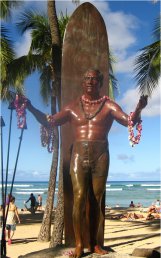 Probably the most famous surfer in the world, Duke Kahanamoku, resurrected the sport of surfing in Hawaii and introduced it to the world. Duke grew up during the late 19th, early 20th century in a Hawaii that was beginning to rediscover the ancient art of surfing that had almost been lost. He spent his time honing his surfing skills at Waikiki, where he surfed on a traditional 16' Hawaiian long board. By 1911, Kahanamoku was breaking world records all along the Hawaiian beaches. In 1912 Duke qualified for the Olympics, where he brought home three gold medals, two silver medals, and a bronze.
Duke Kahanamoku enjoyed his status as a surfing representative for the world. He traveled from country to country giving surfing exhibits to curious crowds. Kahanamoku introduced surfing to an international audience that had never experienced anything like it. He eventually took up residence in Southern California, where he participated in movie productions that helped build the popularity of surfing throughout the United States.
Kahanamoku was instrumental in the development of surfing in Australia. In December of 1914, Duke gave a surfing exhibition at Freshwater Beach in Sydney. The Australians embraced surfing right away, and they hail Kahanamoku as the father of Australian surfing to this day. The board that he used in his original exhibition is still on display at the Sydney Freshwater Surf Club, and a statue of Kahanamoku was erected near the site of his first Australian surfing exhibition.
We continue our surf history articles with a look at Southern California Surfing Culture
wow this is so awesome...i love surfing! I am only 14 bit it is still so awesome i lived in Hawaii for 6 years!!! WOOT!♥
ive always wanted to go surfing but i live in Canada so i cant
You might be suprised to hear that you can go surfing in Canada. There are waves on the east and west coast, and also on the Great Lakes. The water's cold, but modern wetsuit technology is suprisingly good.
Plus, you can also travel somewhere warmer and give it a go.
Correction: Duke Kahanamoku surfed in the early 20th century.
You are correct, I've updated the article. Thanks
Awesome Hawaii! I heard the hawai was the best place to surf and enjoy the beach. Thank you for sharing your skin care experience.
I learned to surf in Hawaii I really want to go back I love Hawaii :)
This was so helpful for a school project tnhankk you
Thank You this was helpful for a school project : )